Mohs Reconstruction
Improve the appearance of a Mohs surgery scar with multiple treatment options.
Skin cancer can be devastating. Even after a cure, the scars left behind can have a severe impact on a patient’s self-esteem. Midwest Facial Plastic Surgery offers several Mohs Reconstruction treatment options to directly address a “Mohs Defect,” or the hole that results from a skin cancer removal. These treatments may be undertaken immediately after your Mohs surgery or delayed several weeks, depending on the size and location of your scar.
Mohs Reconstruction Treatment Options
In general, there are four treatment options for Mohs surgery scar repair. These options are as follows:
Learn more about each below.
Mohs Reconstruction Indications
Reconstruction is indicated for a surgical wound (or “defect”) that is unlikely to heal well on its own. It is typically recommended in these situations:
- Wounds on sensitive areas (eyelids, nose, lips) needing repair to prevent distortion
- Large or deep wounds extending into underlying fat, muscle, or cartilage
- Wounds in high-tension areas prone to wide, thick, or puckered scars
Mohs Reconstruction Benefits
When reconstruction is indicated, its goal is to repair the wound, minimizing scarring and maximizing function. The primary benefits include:
- Improved appearance of scarring
- Expedited healing
- More uniform healing
- Diminished appearance of scarring
Common Areas for Reconstruction
The face has complex and delicate anatomy. Our surgeons are subspecialists in facial procedures, applying precise techniques to restore both form and function to these sensitive areas.
Nasal Reconstruction After Mohs
The nose is a prominent, three-dimensional structure, making nasal reconstruction after Mohs particularly complex. Our surgeons utilize advanced techniques, including flaps and cartilage grafts, to reconstruct the nasal framework and skin, aiming for a result that appears natural and maintains clear breathing.
Cheek, Eyelid, and Ear Reconstruction
Reconstruction of the cheek/eyelid/ear after Mohs requires special attention. For eyelids, the priority is protecting the eye and preserving movement. For cheeks, the focus is on restoring a smooth, natural contour. Ear reconstruction aims to rebuild the intricate cartilage folds of the ear.
Mohs Reconstruction Treatment Options
In general, there are five treatment options for Mohs surgery scar repair. These options are as follows:
- Healing by Secondary Intention
- Skin grafting
- Composite Grafting
- Local flaps
- Regional flaps
Learn more about each below.
Healing by Secondary Intention
In some instances, Mohs surgery scars are not surgically treated, and the defect heals by “filling in” or Secondary Intention. Whether or not this option is chosen is primarily dictated by the location, size, and depth of the defect. The duration of time for healing by this Mohs surgery reconstruction varies, but typically takes 4-12 weeks.
The advantage of this method is that no additional procedures are required, and usually, minimal visibility of the Mohs surgery scar is evident. The potential disadvantages are a depressed, white, or hypo-pigmented scar.
Skin Grafting
Skin grafting is a frequently employed technique. Skin is typically harvested from in front of the ear or collar bone region and is used to fill the defect. The area in front of the ear is also the exact location where an incision for a facelift is placed. The removal of skin from in front of the ear on one side of the face will not create facial asymmetry. It is very typical for skin grafting to be delayed for one to two weeks, or even longer, so that a deep defect can fill in.
Because the skin graft lacks a blood supply, survival is improved by having a healthy area to “transplant” the skin. Several options exist to prepare the Mohs defect site. Cleaning the wound with peroxide and applying Aquaphor® ointment is one option, and placing a “biologic” or antibiotic dressing is also commonly done. Which method is used will be directed by your Facial Plastic Surgeon. It is not uncommon that more frequent clinic visits are also used for wound cleaning.
Composite Graft
A composite graft is another frequently utilized reconstructive option. The technique for closure uses tissue composed of skin and cartilage. The ear is used to supply a composite graft. Harvesting or removal of a composite graft from the ear will not affect hearing or distort the ear. The use of a composite graft, however, frequently requires minor additional procedures to maximize the overall reconstructive site.
Local Flaps
Local flap closure is another frequently utilized procedure. The technique for closure uses skin adjacent to the defect. Frequent types of flaps include: advancement flaps, bilobed flaps, rhombic flaps, and island pedicle flaps. The advantages include the use of similar tissue or skin to reconstruct the defect, and the procedure is completed in a single treatment session. It does, however, frequently require minor additional procedures to minimize the appearance of the scar.
Regional Flaps
Regional flaps are used when larger defects are present and when multiple layers of tissue have been removed, such as skin, cartilage, and nasal lining. Typically, a minimum of two surgical procedures is required, with the first being the most involved and the second being relatively straightforward. Each procedure is separated by 6-8 weeks. Often, skin is borrowed from one area but is left attached to its origin.
The site of origin provides the blood supply to the skin used to cover the defect. Once the rotated flap has had an opportunity to develop a blood supply from the surrounding tissue, the original blood supply is removed at the second surgical procedure.
What to Expect From Consult to Follow-Up
We guide you through every phase of the process, coordinating closely with your Mohs surgeon or dermatologist for seamless care. Your journey begins with an initial consultation to assess the defect, review your medical history, and discuss your goals. We then develop a personalized surgical plan that outlines the chosen technique and timing.
The reconstruction itself is typically an outpatient procedure performed with anesthesia for your comfort. Your surgeon will meticulously execute the planned repair, whether it involves a skin graft or a complex tissue flap. After your procedure, we will schedule follow-up visits to monitor the healing process and discuss any potential scar refinement.
Results & Longevity
The primary goal of Mohs reconstruction is to restore a natural appearance and normal function. While a scar is an unavoidable consequence of any surgery, our surgeons are experts in placing incisions to minimize their visibility. Scars will mature and fade over many months, and the final results are long-lasting.
See Real Patient Results
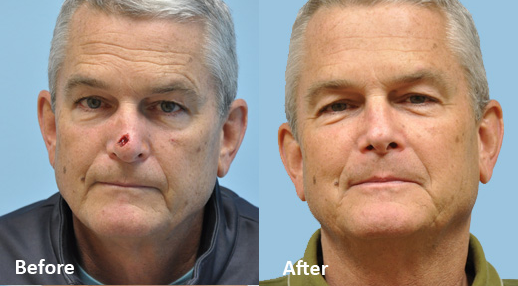
Viewing our patients’ outcomes can help you understand the possibilities of reconstruction. We invite you to browse our gallery to view Mohs reconstruction results performed by our surgeons.
Why Choose Midwest Facial Plastic Surgery
At Midwest Facial Plastic Surgery, our entire practice operates on a core philosophy of precision, empathy, and personalized care. Our team of dedicated facial plastic surgeons in Minneapolis has extensive experience in complex facial reconstruction. Patients and peers recognize our surgeons for their knowledge, experience, and compassionate approach. Our entire staff is known for being warm and supportive throughout the patient’s journey.
Frequently Asked Questions about Blepharoplasty (Eyelid Lift)
How long does it take to recover from Mohs reconstruction?
Recovery time varies based on the extent of your surgery. Most patients can expect some swelling and bruising for one to two weeks; however, your surgeon will provide a more specific timeline based on your personalized treatment plan.
Is Mohs reconstruction painful?
Patient comfort is a top priority. The procedure is performed with anesthesia, and most patients report feeling manageable discomfort, often described as soreness or tightness, which can be controlled with prescribed or over-the-counter medication.
Will I have a scar after Mohs reconstruction?
Yes, all surgical reconstructions will leave a scar. However, our surgeons are specialists in facial plastics and use meticulous techniques to minimize scarring, placing incisions in natural skin folds or creases to make them less noticeable as they mature.
When can I return to normal activities after Mohs reconstruction?
Most patients can return to work and light activities within one to two weeks. Your surgeon will advise you to avoid strenuous exercise and heavy lifting for several weeks to protect the surgical site and promote proper healing.
Is Mohs reconstruction done on the same day as the cancer removal?
This varies. Sometimes the reconstruction is performed immediately after your Mohs surgeon confirms the cancer is gone. In other cases, especially for complex repairs, the reconstruction may be scheduled for the following day or a later date to allow for optimal planning.
Schedule Your Mohs Reconstruction Consultation
Are you interested in learning more about Mohs surgery reconstruction in Minneapolis? Schedule a consultation with our staff to find out if it is right for you. Our surgeons will make every effort to educate you on which method would be best for you. Contact our Vadnais Heights, Eagan, Lakeville, & Woodbury clinics for a consultation.
Related Procedures
Before + After Results
View before and after photos of surgeries performed by facial plastic surgeons Dr. Christopher Tolan, Dr. Garrett Griffin, Dr. Sebastian Sciegienka, and Dr. Anna Bakeman in Minneapolis, MN.